
Allan John Adcock
Celebrated on: September 5, 2024
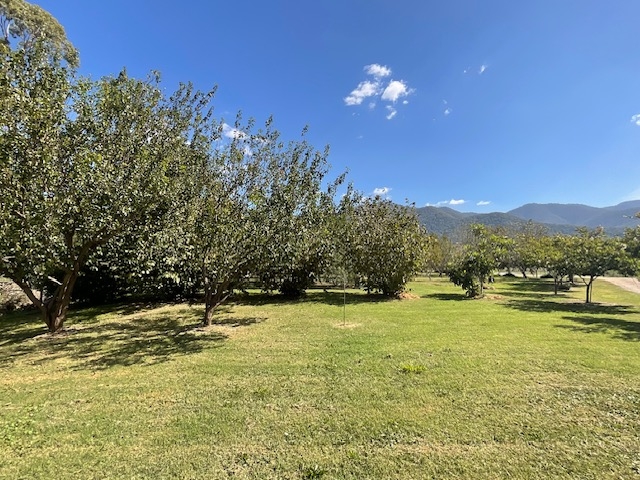
In the orchard at Kevin and Heather’s farm in Tawonga, Victoria
Lucky 35
Why lucky 35. I was born in 1935 in Roma, Queensland. I have always appreciated how lucky I was to be born in Australia.
My Great-grandfather, John Adcock, came to Australia looking for gold around 1856. Before that he had been a “forty-niner” (people who came to California from all over the world in 1849 following the discovery of gold). He apparently failed to find his fortune in California and went back to his trade as a blacksmith setting up shop in East Maitland and later in Tamworth. Years later he brought his family overland to Queensland and settled in Dalby. In those days a trip like that, probably with bullock drays, could take up to a year.
An internet search reveals that the Adcock surname was first recorded in England around the 12th Century. This is the Adcock Coat of Arms. There are several versions of the meaning of the surname “Adcock” and what the Coat of Arms represents. A search of this site is a good starting point: https://www.houseofnames.com/adcock-family-crest.
Grandfather George Adcock was born at Dalby in 1869. He was also a blacksmith and after his marriage in 1888 he set up shop first in Yuelba, then in Surat and finally in 1905 in Roma. My father Kevin Adcock was born in the same year. In 1919, the family moved to a grazing property running about 3000 merino sheep. It was called Mt Hutton, situated about 24kms south of Injune.
My father was a good swimmer and tennis player. He learned to swim in Bungil Creek and represented Roma in a state school swimming carnival in Brisbane in 1917. He finished in 2nd place. (I have the medal, and I believe the event was swum in the Brisbane river near North Quay.) He learned to play tennis at Mt Hutton which had its own tennis court. He played in competition all around the district.
My mother, Catherine Langan, was born in Nanango on 3 March 1912. Her father had migrated from Ireland in about 1880 and married a first generation Aussie-Irish lady, Roseanne Barrett. They had a dairy farm 8kms north of Nanango.
Mum left home in around 1926 to train to be a teacher at Bowen Hills Convent, Brisbane. She taught there until the accidental death by gunshot of her brother Michael in 1931. He was a year or two older than her and they were very close. She returned home and lived there for a couple of years.
In 1933, Mum travelled from Nanango to Injune to be governess to the Coleman children. Their family property bordered Mt Hutton. Mrs Coleman was keen for Cath, aged 21, to meet Kevin, aged 28 (both single). She took her there for a visit. They were married in Roma on May 1, 1934 and returned immediately to live and work on the Mt Hutton property .
I came along nine months later (5 Feburary 1935) and Noel was born on 18 April 1936 in Nanango. Mum had returned there to be near her mother, who sadly died ten days after Noel’s birth. After that we all continued to live at Mt Hutton until Dad joined the AIF in July 1940. They were happy times and I have memories of:
• The sheep shearing and roasting lambs tails in an open fire and eating the blackened result;
• Riding “my” horse Toby (Photo below shows five Adcock cousins on Toby. From the front they were Lindsay, Gloria, Noel, Eva and Allan);
• Watching the killing and butchering of sheep in the meathouse. The meat was stored there. The long roof overhang and water filled gutters around the inside floor kept it cool. The meat was used fresh or salted down;
• Frozen taps on water tanks in winter;
• Crossing the creek in a tub to raid the peach tree;
• Having frozen bare feet from walking on grass covered with frost;
• Seeing Uncle Baden’s mare Isky win a race in Injune and ridden by my cousin Jack Adcock
When Dad joined the AIF in 1940 we left Mt Hutton and stayed with relatives in Brisbane. One of these homes was on the river at Bulimba.To get there we travelled by tram to Hamilton and then crossed the river by ferry. I remember seeing the flying boats land on the river from this home.
Some time in 1940 we visited Dad at the Redbank Army Camp. Dad is on the Right.
At one stage Noel and I went to the Coolangatta convent as boarders for about two weeks, while Mum was searching for somewhere to live. I think she must have advertised to share with another family whose husband and father was overseas. As a result late 1940 or early 1941 we went to live at Kalinga with the Lauder family. Gil Lauder was in the 2/10 th 8th Division with Dad in Thailand.
After the fall of Singapore to the Japs in February 1942, when Dad was taken prisoner along with more than 100,000 allied soldiers, the Japs rapidly advanced through the Pacific Islands to New Guinea, and Queensland was in grave danger. The Government urged Brisbane families to consider moving with their children to western towns. Mum found a rented home in Dalby sometime in 1942 and we lived there for about two years.
It was the longest we had lived in one place for some time and we were happy there. Saturday afternoon matinees at the “pictures” was a regular treat. One of the pictures we enjoyed most was “Bataan” which depicted the Yanks belting the Japs. Another was “Sergeant York” in which the yanks belted the Germans.
In summer we learned to dog paddle in the town pool. Often on Sundays we would go “lobbying” (the local slang for crayfishing) in Myall Creek, about a 2 kilometre walk from our home. Equipment for this was a few lumps of meat tied to a string attached to a short stick. This stick was poked into the creek bank. When a cray grabbed the meat the string went taut and was gently pulled in. When the cray appeared in the muddy water it was grabbed by bare hands and then dropped in a bucket. If we took about ten crays home to be cooked it was a good trip.
In the convent school playground there was a maze of air raid shelter trenches about 1.2 metres deep. Fortunately they were never needed for shelter, but when they were not filled with rainwater they were good to play in.
A little dog we named Tawny somehow became part of our family for a time – until he took a shine to another family when he followed us to school one day. Eventually Mum gave him to them (when we were leaving to go to Taroom).
Uncle Baden (Dad’s brother) had asked Mum to come and help his wife Eileen (Mum’s sister) as she had a son, Geoffrey, aged about 12 months and was expecting another in a few months (Darcy). Baden was licensee of the Taroom Hotel and Eileen looked after the guests and did the cooking.
Baden drove down to Dalby and picked us up in an old vehicle. It was a memorable trip and the roughly 260 kms took two days on muddy black soil roads. There were frequent stop to put patches on tyres. (New tyres and tubes were unavailable in war years.)
Life was good there for seven months or so, until we came to Mum’s old home outside Nanango for the Xmas holidays. Noel and I liked helping there with the milking. The Isabella grapes growing on the very large trellis near the house were always great at that time of the year.
After the holidays Mum took Noel to a property outside Dirranbandi where she got a governess job and she sent me to board in a private home in Warwick and go to the Christian Brothers school there. I did not enjoy this at all. Noel and I had never been separated and I missed him and had trouble making friends at the boarding house and at school. The lady who ran the house wrote to Mum and told her I was not doing well, so after Easter we all returned to Taroom for a few months.
One day while we were playing on the large front top floor verandah, we were watching some cattle being driven across the Dawson River bridge and away from the town. We saw the lone stockman’s horse fall on top of him. We rushed to the bar and told Baden what we had seen. The stockman had serious head injuries and spent months recovering. About 18 months later in Pittsworth he thanked us for probably saving his life.
At one stage a circus came to town and set up on the town common near the river. It was very popular with all kids for an after school visit. One afternoon we were told an elephant was missing and all joined in the search. He was found not far away, happily grazing on the river pasture.
By mid 1945 the war with Germany was won and the war with Japan was nearing victory. I think Mum wanted to be nearer to Brisbane so she placed us in the convent boarding school in Helidon.
On August 15 the nuns told Noel and I to come to listen to the the radio. We were very excited when we heard that the Japs had surrended. Was Dad still alive and if so, would he soon be home? He was still alive but it was some weeks before mum got a telegram from the Red Cross confirming this. Then it was a couple of months before he was well enough to come home.
The great day finally arrived in October 1945. We were picked up from school and driven to Clapham Junction, where Dad was arriving on an interstate train from Melbourne. It was like a dream. He was still very thin and unwell, but he was home, and we doted on every word he said.
Back to boarding school for us! Dad had some leave to let off some steam, but he was still in the army and had return to camp at Holland Park. He spent some time between there and Greenslopes Military Hospital before his discharge in January 1946. He received about 800 Pounds ($1600) in “Deferred Pay”. With this he bought the license of the Beauaraba Hotel in Pittsworth. We all went to live there in February 1946.
As a child I would not have appreciated how difficult it was for a married couple separated by war for nearly six years to rekindle their relationship. Though it was never spoken of, I am sure Dad would have been impotent for some considerable time, probably years. I was disturbed by violent arguments in the middle of the night during this period. Mum was also anxious to make up for lost financial opportunities while dad just wanted to enjoy his new found life. Sadly this caused a lot of friction.
Life for Noel and I changed completely. We now had someone to teach us to play cricket and most importantly how to box so we could defend ourselves against school bullies. We also played our first games of rugby league at the Pittsworth convent.
It was in Pittsworth that I got the idea of making money by breeding pigeons. I made a sort of a cage with scrap material (the only material available to most in 1946). A schoolmate named Leon had a lot of pigeons and was happy to sell me some for 1 shilling (10 cents) each. It was not long before they found a way out of the cage and were happily back home at Leon’s place.
The pictures (movies) were a popular place for us on Saturday nights. On one such night Mum woke up in the middle of the night and went to check on her boys. Noel was sound asleep in bed, but my bed was empty. She woke Noel to find out where I was– he didn’t know. Eventually they worked out that I had not come home and must have gone to sleep in the theatre. Of course the theatre was locked up tight when they got there (about 200 ms up the main street). They worked out approximately where we had been seated and banged on the walls. A fold down window had not been properly locked and Noel was helped through the window to wake me up and have us both climb back out the window.
There was a wood stove in the hotel kitchen so there was a large woodheap out the back. We were shown how to use an axe and to always stand clear when someone was chopping wood. Apparently, one day I did not heed this advice and I copped a large piece of wood on the chin and lost my middle front tooth. For some years after I had a gappy smile.
We left Pittsworth at the end of 1946 as the license had been sold for about 100% profit. This historic hotel was burnt to the ground about 1948.
The next school year we were sent to board at the Christian Brothers school in Eagle Heights on Mt Tamborine. In the meantime our parents had moved to the Commercial Hotel in Crows Nest in partnership with Dad’s brother Baden.
Early 1947 was very wet in Tamborine. We had never seen rain like it. In any case we were not happy there. I think we had thought our days in boarding schools were over when Dad came home. We did play some cricket there and on one occasion while fielding back past the bowler I reached high to take a ball above my head. It clipped the top of my right hand third finger, which was very painful. I was too scared of more pain if I told the teachers, so I kept it to myself.
Happily, we went to Crows Nest for Easter and refused to return to Tamborine, instead going to the Convent School across the road from the Pub. Mum discovered my sore finger and took me to the doctor. He said it was out of joint and tried to reset it without success. I had to go back later so he could attempt to reset it under anaesthetic. Again he was unsuccessful, and it has remained out of joint ever since.
I should mention that the Commercial Hotel was burned to the ground about 1950.
We left Crows Nest at the end of 1947 and Dad’s next venture was as the licensee of the Southbrook Hotel. From there we took the rail motor to Toowoomba on Monday mornings and back on Friday afternoons. In between we went to the Christian Brothers College and boarded at the private home of Mrs Donnelly and her children. Mum taught us to cook lamingtons there. We also annoyed the local mickey (minor) birds by setting traps with cardboard boxes baited with bread and held up at one end by a stick with a length of string attached. We caught and released them just for fun. In Toowoomba we were doing okay at school and playing cricket and rugby union at sport without distinction.
By early 1949 we had moved to a house in South Toowoomba and Mum and Dad were running a fruit shop in Ruthvern Street. It was while we were living there that Helen was born on 6 July 1949. Before the birth Mum scared us by saying many times that she would not survive the birth because of her bad heart. This “bad heart” kept her going for another sixty years plus.
Also in early 1949 I had a severe fever and spent three weeks in St Vincents hospital in Toowoomba. It was diagnosed as Rheumatic Fever and I was told to avoid all physical activity and all sport. I missed about 8-10 weeks of school in sub-junior (grade 9). I am certain this diagnosis was wrong and that I probably had glandular fever. It was well into the year before I played any sport.
At this time they had a boxing tournament at school which I would have loved to have been part of. Instead I became Noel’s coach. He did very well, winning through several rounds of the tournament.
Soon after Helen was born we moved to the Merringindan Hotel and again travelled by rail motor to Toowoomba on Mondays and home on Fridays. We boarded in Bridge St in a private home with Miss Hogan and her mother. Miss H had the daily evening meals set for each day of the week. We dreaded Tuesday nights–tripe night.
The license at Merringindan had been sold before Xmas 1949. During the holidays Noel and I were sent to where Carmel and Jim Harvey were managing a cattle property on the Condamine River. We were put on a train in Oakey to travel to Miles where we arrived about 1 am then slept on a bench at the railway station until the mailman picked us up and took us on his delivery run. His last call was at Sheahan’s Station at about 3 pm, where Carmel picked us up in a horse and buggy for the last 8 or 10 Kms to where they lived on one of the Sheahan family properties.
The holiday there was good because of the isolation. The small house was only metres from the river which was shallow and easy to explore and cross. There were no rabbits on their side and they were everywhere on the other side. We tried shooting them without success.
When we went there we took a pup we called “curlypup” , but he grew big while we were there. When we left he had to stay behind.
In the meantime Dad had bought the license of the Columbia Hotel in Gympie and so about mid February 1950 we moved there travelling by an old Ford ute from Nanango.
This time Noel went to the high school and I went to The Christian Brothers. Because I had missed the first two weeks of the new school year in Junior (grade 10) I had a very difficult time. I was not a good student and had to stay in school for sport periods to try to catch up. By mid year the Headmaster told me I was wasting his and my time. That made me try a bit harder and, fortunately, one of the science teachers from the high school always had a drink at the Columbia after school. Dad told him I was having trouble with physics and chemistry and he suggested he could give me coaching on Saturday mornings. As a result by the time we did junior I had moved from near the bottom of a class of 22 to fifth.
One of my regrets is that we moved so frequently and Mum did not think that the first couple weeks of school were important, so I often missed those vital few weeks. Fortunately my children and grandchildren have had greater stability and it has paid off for them.
One of my chores in Gympie was to milk a cow every morning before going to school. At 7 am in winter in Gympie it is not a good place to be – in a frost covered paddock. I was glad when she finally went dry.
About mid year 1950, we went on a Sunday fishing trip to Tin Can Bay. Our bait was mullet gut which gets all over your hands and has a vile smell. I don’t remember if we caught any fish, but the next day I had a badly infected pimple on my nose and was rushed to Gympie Hospital. The infection was obviously caused by the vile bait and nose scrathing. A few large penicillin needles in the bum soon brought it under control.
At that time Gympie was dotted with large mullock heaps – piles of uneven stones of all shapes and sizes cast off from the gold mine shafts. Generally about 15 to 20 metres high they were a challenge to climb because of instability and there was also the thought we might find gold. They are all gone now.
On Sundays in the cricket season, I was sent with the pub cricket teams to small towns around the district. I was there mainly there to make up the numbers. The other players aged in their twenties were there for a little cricket and a lot of drinking. At that time the law did not allow pubs to open on Sundays, but in small towns the police were just as likely to be having an illegal drink themselves or at least not concerned about this law. We travelled in an open truck with most of us sitting on the floor in the back.
During 1950 Uncle Claude, his wife Freda and their two young girls visited. The elder girl, Denise, was swinging on the steel rail fence one morning, when she fell and broke her arm. She was taken to hospital where they gave her an anesthetic and set the arm. Later in recovery she vomited and choked to death on the remains of an orange she had eaten earlier that morning.
At the end 1950 I had passed the Junior Statewide Exam and went to work in Woolworths for the three weeks leading up to Xmas. I was serving behind the counter. (Checkouts had not been invented then). Gympie in December is very hot and muggy and I would get very overheated getting to work then go into the airconditioned shop. As a result I had a very heavy cold by Xmas which developed into pnuemonia and I was in hospital just after Xmas.
Mum had booked me on a Young Australia League tour to Sydney and Canberra leaving about 27 December. Of course I was not able to go so Mum arranged for Noel to go in my place. Noel enjoyed the tour and I recovered in hospital.
In February 1951, to make up for missing that tour Mum sent me to Cairns by train to stay with Uncle Jim Langan, who was canecutting there. He had a flat near the centre of Cairns. Train trips were different in those days with steam engines and wooden carriages. Stops were made at the major towns on the way to allow passengers to go to station refreshment rooms for food and for those inclined to go to station bars for alcoholic drinks. These stops could vary from 1/2 hour to 1 hour and as a result the trip to Cairns took close to two days.
I had just turned 16 but I coped well and went on Tours to Green Island, Kuranda Rail and others on my own. I had Mum’s Brownie camera and took lots of photos. I returned to Brisbane on the cruise ship Manunda and then travelled by train to Gympie.
Later in 1951, the license of the Columbia Hotel was sold and we prepared to move again. Marie was born at this time in Gympie (on 27 April). She was about three weeks old when we travelled in Dad’s old utility to Margate where Mum had rented a holiday home for a month.
Mum arranged for me to have an interview for a job in the State Public Service. They were concerned that I had had pnuemonia and insisted on a medical checkup prior to accepting me. On Monday 4 June 1951 I reported to the Public Service Department and was sent to The Queensland Housing Commission in Edward St. I was very nervous and by lunchtime I threw up and the boss sent me home. After that inglorious start I did well. For the first few weeks I travelled by bus to Sandgate and from there by train to Central Station.
By the middle of June we had moved in with Uncle George and his wife Lizzie at Ipswich Road. (The house was on the outbound left hand side about 200 metres past where the PA Hospital is now). Within a short time Mum & Dad bought a house in Chale St, Moorooka. I travelled to work from there by bus.
Compulsory National Service was introduced in Australia in about 1952. I went into the air force at Archerfield for six months on 15 June 1953. After the first three weeks of continuous marching and drilling I was working in a hangar as a clerk — not very exciting.
I learnt to play pontoon and drink beer but not much else. Some pranks are worth reporting. One of the guys we called Droopy was not in the hut after mess one evening so his bed and locker were put in the ceiling. When he returned he was shocked at the empty space where his gear should have been. On another occasion a chap who had a steady girl went AWL to take her out. He arrived back very late and drunk. After he went to sleep he was carried out bed and all and left on the parade ground. He was very confused when he woke early on the cold morning out in the open. He tried to carry/drag his bed back. The guys took pity and helped him.
One day when we were in our hut after lunch, the radio news reported an accident at Newstead earlier that morning. Several young men were badly injured when a balcony rail collasped at their workplace and they fell backwards several metres onto cement. They gave the names and one was Noel Adcock. I got emergency leave and went to BGH to see Noel. He had a broken back and was in plaster. Noel took many months to recover.
I completed national service on 15 December 1953 and returned to work at the QHC.
In September 1954 I went on holidays to Mt Hutton where Jim and Carmel Harvey were living. Jim was managing the property which now ran Aberdeen Angus cattle. I enjoyed helping Jim, boundary riding, mustering and driving cattle to the rail in Injune, a distance of 24 kilometres. This included sleeping on the bank of a creek and having a saddle for a pillow.
Early in 1955 Mum sold the house at Moorooka and bought an old house at the corner of Belgrave St and Regent Lane, Petrie Terrace. It was close to the city, about ten minutes by the Ashgrove tram. Just down the road to The Normanby corner there was a telephone booth and it was from there that I telephoned “Aunty Ruby” and asked her to call my new love Betty Cockburn to the phone. Her dog Janey would bark through side window and Betty would get the message that I was calling.
Betty and I had been “going out ” for a few weeks and of course we are still together and have raised four of the best offspring in the world.
Our outings took in the city movie theatres (there were six within three city block but none of them operate today) and also suburban theatres. Our favourite was The Hollywood at Greenslopes (about 300 metres from the Cockburn home in Thomas St). Betty and I were there most Saturday nights cuddling in the canvas seats.
We went on “work” Sunday bus trips to Tweed Heads, Kingscliffe and Fingal, when they were just little country towns and not the tourist resorts they are today. There was only one highway to the coast and when we left Surfers there were only sand dunes between the road and the beach for miles. This is where Broadbeach is today.
Betty always knew we would marry so we saved our money and planned to buy land and build a home. We found a relatively cheap block at 92 Baringa St, Morningside. I think it cost $350 in today’s currency. We designed our home and had plans drawn by the Housing Commision who called tenders. We accepted a tender for $5600.
While this was going on, we had become engaged on 4 February 1958 and planned to marry on 15 November that year. All went well and we married at the Catholic Church in Coorparoo with a reception at Holland Park. After this we drove in my old Morris utility to Noosaville. Most days on Noosa Beach we were the only ones there.
Our home was completed in mid December that year and we moved from Greenslopes to Baringa St on 19 December. The hard work had commenced many months before when Betty’s father, Alec, and I had spread many loads of ashes filling to raise the level of the land. It continued after we moved in with painting, papering, floor covering, making gardens, a lawn and eventually a “Home”.
We have been fortunate and had a happy life and we are very proud of our children and grandchildren. This is a photo of us on a Princess Cruise in 2014. We hope to cruise along together for a few more years.
Allan Adcock
January 2017
Sorry, no records were found. Please adjust your search criteria and try again.
Sorry, unable to load the Maps API.
Back to Memorial Map